


LM2596 in Action: Case Study of Its Application in Power Supply Units

When it comes to reliable voltage regulation, the LM2596 DC-DC converter stands as a trusted choice among electrical engineers and hobbyists. This chip plays a vital role in buck converter topology and power supply design.
What is LM2596
The LM2596 is essentially a voltage regulator designed as a buck converter. It can handle input voltages up to 40V, efficiently stepping them down to produce a lower, stable output voltage (Vout) that can be as low as 1.23V or as high as 35V. Thanks to its BJT technology, the converter can achieve excellent regulation performance.
What's inside a LM2596?
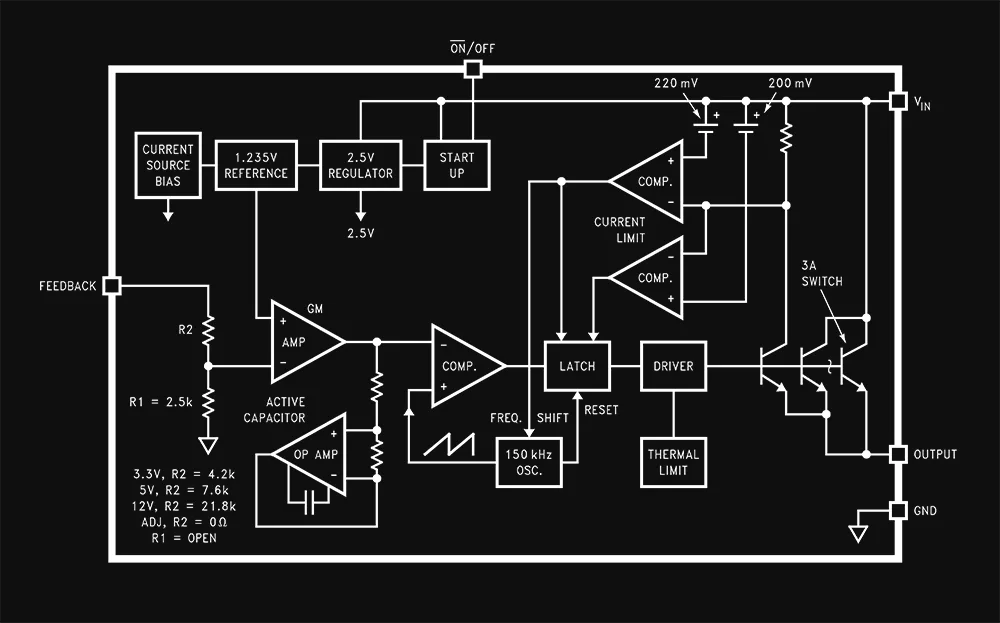
The LM2596 is an integrated circuit (IC) designed to function as a voltage regulator in a buck converter topology. While you won't be able to see the internal components just by looking at the chip, its datasheet will reveal a variety of built-in features that facilitate voltage conversion and regulation. Here's a general breakdown of what's inside:
Internal Switching Transistor (BJT)
The LM2596 typically incorporates an internal bipolar (NPN) power transistor that acts as the switching element. This transistor allows the LM2596 to switch current paths, thereby stepping down the voltage.
Control Logic
The internal control logic manages the timing and switching operations. It usually operates at a fixed frequency and is responsible for the opening and closing of the internal transistor.
Feedback Loop and Error Amplifier
The LM2596 includes a feedback loop that measures the output voltage (Vout) and compares it to a reference voltage. Any deviation results in an error signal, which is amplified and used to adjust the duty cycle of the switching transistor to keep the output voltage stable.
Voltage Reference
An internal voltage reference sets the standard against which the output voltage is compared. This is essential for the regulation process.
Protection Circuits
The LM2596 includes built-in thermal shutdown and current limiting to protect the IC and connected components from damage.
External Components: Beyond the IC
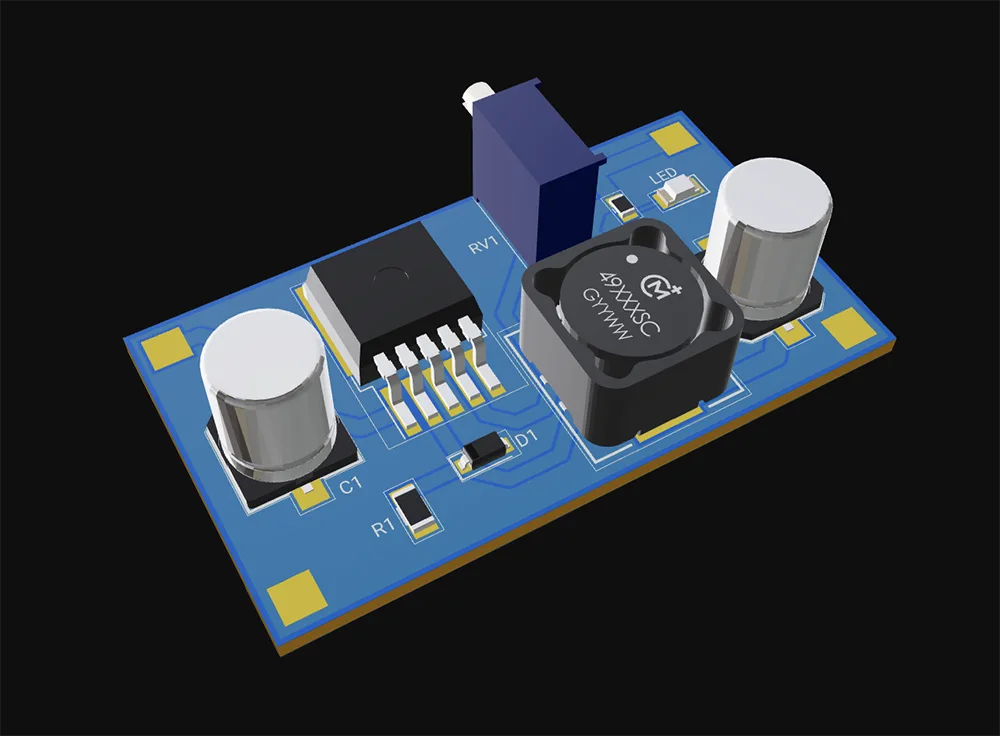
Although the LM2596 itself is an integrated package, its effectiveness in a buck converter circuit relies on external components like inductors, capacitors, and sometimes diodes and resistors. The IC has pins to connect these components.
Voltage Inputs and Outputs
The LM2596 can handle a wide range of input voltages. Whether it's a 40V input from a power converter or as low as 4.5V, the LM2596 ensures a reliable output.
LM2596 Specifications
Vin and Vout
Vin is the input voltage fed into the circuit, while Vout is the output voltage regulated by the LM2596. This makes it extremely versatile, catering to both high and low voltage requirements.
The Power Supply Scenario
Power supply units often incorporate this DC-DC converter for its non-synchronous regulation capabilities. The LM2596 is capable of driving up to 3A in specific conditions, which is quite sufficient for many types of electrical loads.
Additional Components and Parameters
25V, 30V, and 35V Capacitors
Different voltage ratings like 25V, 30V, and 35V for electrolytic capacitors are often employed based on the desired output and input voltage ranges.
Ripple Factor
Voltage ripple is an essential factor to consider, and the LM2596 excels in maintaining a low ripple, thereby ensuring a stable output.
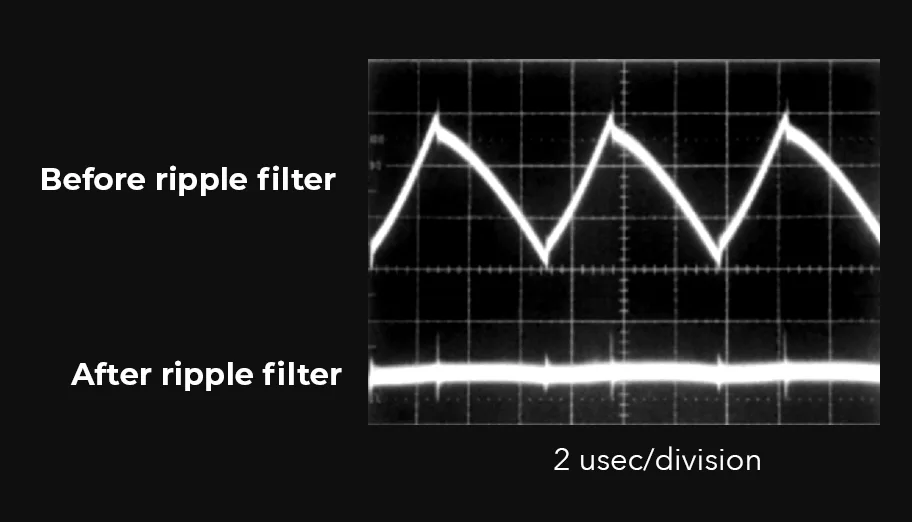
Different inductor types or core materials produce different amounts of this characteristic ringing or ripple. Ferrite core inductors have very little core loss and therefore produce the most ringing. The higher core loss of powdered iron inductors produce less ringing. If desired, a series RC can be placed in parallel with the inductor to dampen the ringing.
Frequency and Switching
The LM2596 operates at a fixed frequency, aiding in easier filter design. The chip incorporates internal switching transistors, further simplifying the circuit topology.
Documentation and Design
Datasheets and Webench tools are useful resources for understanding the LM2596 circuit's pinout and diagram. Datasheets provide detailed specifications, while Webench helps in simulation and layout design for your PCB.
Advanced Usages Requirements
MOSFETs
For higher power than the LM2596 can deliver, designers move to a buck controller that drives external MOSFETs.
Example LM2596 Buck Converter Module
In Summary
The LM2596 is a versatile and robust DC-DC converter, central to many power supply systems and voltage regulator applications. Its excellent performance, including a broad voltage range of up to 40V and low ripple, make it a preferred choice. Whether you're focusing on inductor specifications, capacitor types, diode characteristics, or transistor functionalities, this IC has proven itself as an efficient voltage regulator in asynchronous settings.
Practical Tips
Before diving into your project, make sure to refer to datasheets for the most accurate information. Diagrams are your best friend when laying out your PCB. Remember, you can use the LM2596 in adjustable setups by modifying the resistor values to achieve custom voltage outputs.
LM2596 offers a reliable and efficient solution for all your voltage regulation needs, serving as the cornerstone in many buck converter and power converter applications.
More in PCB Design & Engineering Fundamentals

What Is a PCB? A Beginner's Guide to Printed Circuit Board Design

What is Schematic Design? All You Need to Know

PCB Stackup Design: How to Build the Right Layer Structure

Best PCB Routing Techniques for Clean Circuit Board Layouts

How to Read PCB Schematics: A Beginner-Friendly Guide

PCB Schematic Best Practices for Clean Circuit Design

Schematic Capture Explained: How Engineers Create Circuit Diagrams

What Is EDA Software? A 2026 Guide to Tools and Companies

Best Schematic Capture Software in 2026: 7 Tools Compared

Common Schematic Design Mistakes and How to Avoid Them

PCB Netlists Explained: How Schematics Connect to Layouts

What Is a Netlist? Understanding the Basics of Electronic Design Automation

PCB Symbol Design: Best Practices for Clean Schematics

Making Parts Just Got Easier: Introducing Parametric Symbols

Create Satisfying Schematics with these Updates

Electronic Circuit Design Explained: From Schematics to PCB Layout

Designing PCBs: What Are the Essential Steps

Hardware Design Workflow: From Schematic Capture to Manufacturing

What Is a Functional Block Diagram and Why Is It Critical in System Design

PCB Design Basics: What You Need to Know Before You Start

Diode Symbols: How to Identify Common Diodes

Ultra Librarian joins Flux to Take the Hard out of Hardware

Flux Now Has the World's Largest eCAD Part Library

Capacitor Symbols Explained: Types, Polarity, and Schematic Use

MOSFET and Transistor Symbols Explained: NMOS, PMOS, NPN, and PNP

How to Convert PDF Schematics into Editable EDA Files Using AI

Resistor Symbols Explained: Fixed, Variable, Thermistor, and Photoresistor Symbols

Fuse Symbols Explained: Electrical, Thermal, and Circuit Protection Symbols

How to Learn PCB Design: A Step-by-Step Roadmap for Beginners

Crosstalk, Reflections, and the Real Challenges of Signal Integrity

What Is Signal Integrity in PCB Design? A Practical Guide

High-Speed PCB Design: Layout Rules, Signal Integrity, and Routing Best Practices

EMI/EMC in PCB Design: How to Reduce Interference

PCB EMI Problems: Causes and Solutions

Differential Pair Routing Guidelines and Controlled Impedance Best Practices

PCB Impedance Control: A Practical Guide for Engineers

Introducing Curved Traces in Flux

Analog vs Digital PCB Design: Key Differences Explained

Pi Filters Explained: Design, Components & Applications

RS485 Explained: Wiring, Specifications, and Applications

What is RS232?

SPI vs. I2C: Which Communication Protocol Should You Use?

RJ45 Connectors: Pinouts, Categories, Uses, and Testing

CO2 Sensor Technology: How These Devices Detect Carbon Dioxide

Hall Effect Joysticks: How They Work, Benefits, and Uses

What Is an Oscillator? Beginner's Guide to Oscillating Circuits

Flexible PCB Design Guide: Materials, Layout, and Applications

Rigid-Flex PCB Design: Benefits, Challenges, and Layout Tips

The RF Engineer's Guide to Designing Printed Trace Antennas

SMA Connectors Explained: Types, Applications, and PCB Design Considerations

RC Low-Pass Filter: Formula, Cutoff Frequency & Design

NFC vs RFID: Board Design, Tags, and Reader Choices

Low-Pass vs High-Pass Filter: Differences and Examples

How to Choose a Bluetooth Module for Your PCB Design

Decoding Voltage Regulators: How They Work in Everyday Electronics

Voltage Regulators: How They Work, Types, and Applications

Buck Converter Design: Components, PCB Layout, and Formulas

Buck and Boost Converters: How They Work and Where They’re Used

Guide to GND Fills and Power Planes

Power Distribution Network (PDN) Design in PCBs

PCB Grounding Techniques for Noise Reduction and Stability

Designing High-Current PCBs: Layout and Safety Considerations

How to Calculate PCB Trace Resistance

Voltage Drop Calculations: Formulas, Factors, and Guidelines

AC to DC Converter: The Backbone of Power Electronics

AC-to-DC Converters: How They Work, Types, and Design Tips

Thermal Management in PCB Design: Methods and Best Practices

PCB Thermal Management: Analysis and Design Best Practices

Understanding PPS Fast Charging: What It Is and How It Works

Decoupling Capacitors in PCB Design: Placement and Selection

What Is a Multilayer Ceramic Capacitor (MLCC)?

Tantalum Capacitors Guide: Polarity, Derating & Risks

Amps vs. Volts: Key Differences and How They Work Together

Current Sensor Types: Shunt, Hall Effect, and Current Transformer Comparison

Li-ion vs LiPo vs LiFePO4 vs NiMH for Hardware Design

Never Worry About Stackups Again: Introducing the Stackup Editor

Multilayer PCB Design: Stackup and Routing Best Practices

How to Choose PCB Materials: FR4 vs Advanced Substrates

Blind Vias, Buried Vias, and Microvias: A Complete Guide to PCB Via Types

Exploring Different Types of Vias in PCB

High-Density PCBs just got easier with Smart Vias

How to Use Via Stitching in PCB Design

PCB Design Constraints: What Engineers Need to Know

PCB Constraint Management: How Engineers Control Layout Rules

Design Rule Checking (DRC) in PCB Design: Real-Time vs Batch, Rules, and Common Failures

Electrical Rule Check (ERC) vs DRC in PCB Design

PCB Design Reviews: Best Practices for Catching Errors Early

Common PCB Design Mistakes and How to Avoid Them

5 Common PCB Design Mistakes and How to Avoid Them

PCB Silkscreen Design: Guidelines and Common Mistakes

Smart Polygons: Advanced PCB Design Just Got Easier

Automatically Create Photorealistic PCB Renders

How to Convert from MM to Mils: a Guide for Beginners

What Is Solder Mask? Materials, Colors, and PCB Design Rules

Designing Custom PCB Outlines: Fixing DXF and SVG Import Failures

PCB Enclosure Design: How to Design an Enclosure

How to design a sheet metal bracket for your PCB with a text prompt

How to run thermal and stress simulation on a PCB enclosure in the browser

Designing hinges, snap-fits and moving parts for your enclosure in Flux

PCB IPC Standards Explained: IPC-2221, IPC-2152, IPC-7351, and More

Component Selection in PCB Design: How Engineers Choose the Right Parts

Smarter Part Search Just Got a Major Upgrade

How to Design a PCB Footprint (Step-by-Step Guide)

Protection Circuit 101: Securing Your Electronics from Overcurrent and Short Circuits

Understanding the Flyback Diode: Your Essential Guide to Functionality and Why You Need One

What Is a Zener Diode? How It Works and Where It’s Used

Understanding the Fundamentals: MOSFET Basics for Beginners

NMOS vs PMOS: Differences & When to Use Each

NPN vs PNP Transistors: Differences & When to Use Each

LM741 Pinout: A Deep Dive into a Classic Op Amp

6 Types of Variable Resistors: a Detailed Look at Their Uses
Parallel and Series Resistor Calculator

Resistor Color Code Calculator

SMT vs Through-Hole Technology: Which Should You Use?

How to Use Flux When Soldering Electronics

The Ultimate Guide to Toggle Switches: Types, Uses, and How They Work

What Is the Science Behind Push Button Switches and How They Work

Tactile Switches: Wiring, Debouncing, and PCB Design

Electrical Wire Connector Types and Uses

Board-to-Board Connectors: Types, Pitch and Stack Height

RTD vs Thermocouple vs Thermistor: Sensor Selection

Why Your PCB Is Failing: Debugging Common Issues

555 Timer Guide: Pinout, Operating Modes, and Circuit Examples

Inverting Op-Amp Circuits: Formula, Gain, and Design Examples

How to Wire a Potentiometer: Pinout, Diagrams, and PCB Examples
Let’s start building.

Let’s build your idea together. All you need to do is describe what you want to make, or what problem you want to solve. Flux will work with you to make it a reality.
