


Raspberry Pi Pico 2 vs Pico: Key Differences and Upgrades

In January 2021, Raspberry Pi Ltd made a significant mark on the microcontroller market with the launch of the Raspberry Pi Pico, a $4 microcontroller board powered by their in-house RP2040 chip. Fast forward to August 2024, and Raspberry Pi has introduced the Raspberry Pi Pico 2, which, despite its similar appearance, brings several noteworthy upgrades, making it a compelling choice for makers and professionals alike.
Raspberry Pi Pico 2 keeps the original Pico’s compact, breadboard-friendly format while upgrading the processor, memory, security features, and programmable I/O. This comparison explains what changed from the RP2040-based Pico to the RP2350-based Pico 2, what remains compatible, and which board is the better fit for different projects.
What’s New in Raspberry Pi Pico 2?
Raspberry Pi Pico 2 introduces a series of hardware upgrades while retaining the same physical format and broad hardware and software compatibility as the original Pico:
Enhanced Processing Power
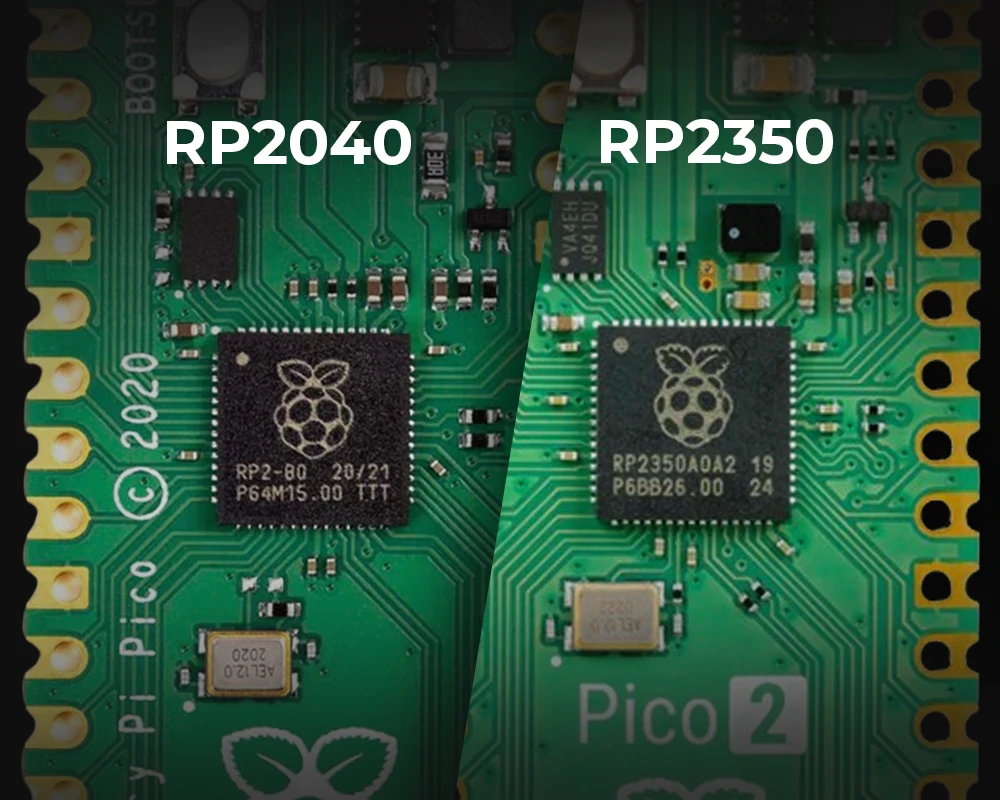
- RP2350 SoC: Pico 2 uses the RP2350, which can boot using either its dual Arm Cortex-M33 cores or its dual Hazard3 RISC-V cores. Only one processor architecture is active at a time. The maximum clock speed rises to 150 MHz from the RP2040’s 133 MHz, while the Cortex-M33 cores also add floating-point and DSP support.
Increased Memory and Storage
- 520KB SRAM: The Pico 2 doubles the SRAM from 264KB to 520KB, allowing for more complex applications and larger datasets.
- 4MB Flash Storage: The onboard QSPI flash storage has also been doubled from 2MB to 4MB, providing more space for program storage and data handling.
Advanced Security Features
- Arm TrustZone and Secure Boot: When RP2350 runs on its Cortex-M33 cores, Arm TrustZone can separate secure and non-secure execution. RP2350 also includes a signed-boot architecture, although secure boot must be deliberately configured as part of the product’s security design.
- 8KB OTP Memory: An 8KB OTP (One-Time Programmable) memory is available for secure key storage, enhancing the security of the Pico 2 for sensitive applications.
Improved Analog and Digital I/O
- ADC resources: The RP2350A chip provides four analog inputs, but the standard Pico 2 board exposes three external 12-bit ADC inputs, matching the number available on the original Pico board. The onboard temperature sensor uses an additional internal ADC channel.
- More PWM Channels: The number of PWM channels has been expanded from 16 to 24, providing greater control over devices like motors and LEDs.
- More Programmable IO (PIO) State Machines: The number of PIO state machines has increased from 8 to 12, allowing for more custom hardware interfaces and complex I/O operations.

Lower Power Consumption
- Improved low-power modes: RP2350 adds enhanced sleep and dormant capabilities. Actual board-level current depends on firmware, clocking, regulators, connected peripherals, and measurement conditions, so designers should validate consumption in the intended configuration rather than relying on a single headline figure.
Support for RISC-V Architecture
- Dual-core Hazard3 RISC-V: RP2350 includes two open-hardware Hazard3 RISC-V cores alongside its two Cortex-M33 cores. A program is built for one architecture, and the chip boots using the corresponding pair of cores; the Arm and RISC-V pairs are not used simultaneously.
Raspberry Pi Pico 2 vs Pico: Key Differences
The biggest differences are the move from RP2040 to RP2350, nearly twice the SRAM, twice the onboard flash, faster and more capable processor cores, additional PIO and PWM resources, and a substantially expanded security architecture.
Microcontroller Specifications Comparison
Microcontroller (MCU)
- Raspberry Pi Pico: The original Pico is powered by the RP2040 microcontroller, featuring a dual-core Arm Cortex-M0+ processor running at up to 133 MHz.
- Raspberry Pi Pico 2: Pico 2 introduces RP2350, which can run on either two Arm Cortex-M33 cores or two Hazard3 RISC-V cores at up to 150 MHz. The Cortex-M33 option adds hardware floating-point, DSP instructions, and TrustZone support; the RISC-V option gives developers an alternative open instruction-set architecture.
Memory and Storage
- Raspberry Pi Pico: Equipped with 264KB of SRAM and 2MB of QSPI flash storage.
- Raspberry Pi Pico 2: The Pico 2 significantly upgrades its memory and storage, doubling the SRAM to 520KB and the QSPI flash storage to 4MB. This increase allows for more complex and resource-intensive applications, making the Pico 2 a more powerful microcontroller for various projects.
Security Features
- Raspberry Pi Pico: RP2040 provides a simpler security model without the TrustZone, signed-boot, hardware TRNG, and glitch-detection features introduced with RP2350.
- Raspberry Pi Pico 2: RP2350 adds a security architecture that includes Arm TrustZone on the Cortex-M33 cores, 8 KB of OTP memory, signed boot, SHA-256 acceleration, a hardware true random number generator, and glitch detectors. These capabilities provide building blocks for secure products, but they still require correct configuration and implementation.
I/O and Connectivity Comparison
Analog and Digital I/O
- Raspberry Pi Pico: The original board exposes three external 12-bit ADC inputs and 26 multifunction GPIO pins. RP2040 also provides two UART, two I2C, two SPI controllers, 16 PWM channels, and eight PIO state machines.
- Raspberry Pi Pico 2: The standard Pico 2 board also exposes three external ADC inputs and 26 multifunction GPIO pins. RP2350 increases the available PWM channels to 24 and the PIO state-machine count to 12 while retaining two UART, two I2C, and two SPI controllers.
Connectivity
- Raspberry Pi Pico: The original Pico has no built-in wireless connectivity. Pico W and Pico WH add 2.4 GHz Wi-Fi and Bluetooth using the CYW43439 wireless chip.
- Raspberry Pi Pico 2: The standard Pico 2 is also non-wireless. Pico 2 W is now available and adds 2.4 GHz 802.11n Wi-Fi and Bluetooth 5.2 while retaining the RP2350 processor, 520 KB of SRAM, and 4 MB of onboard flash.
Power and Physical Specifications
Power Consumption
- Raspberry Pi Pico: RP2040 supports low-power sleep and dormant modes. Board-level consumption varies with firmware, clock configuration, GPIO state, regulator behavior, and attached hardware.
- Raspberry Pi Pico 2: RP2350 expands the available low-power features, including an always-on timer. For battery-powered designs, measure the complete board in its real operating state because connected peripherals and board circuitry may consume more power than the microcontroller itself.
Compatibility and Form Factor
- Raspberry Pi Pico: The board measures approximately 21 × 51 mm and has 40 castellated edge pins. Of these, 26 are multifunction GPIO pins; the remaining pins provide power, ground, ADC reference, enable, and other board-level functions.
- Raspberry Pi Pico 2: Pico 2 retains the same overall dimensions, castellated module format, and pin-compatible layout as the original Pico. It also keeps the Micro-USB connector, allowing many existing carrier boards, accessories, and development workflows to be reused.

Additional Feature Comparison
- Raspberry Pi Pico: Includes a precise on-chip clock and timer, a temperature sensor, and optimized floating-point libraries.
- Raspberry Pi Pico 2: Introduces enhanced low-power sleep and dormant modes, flexible high-speed user-programmable I/O, and the capability to emulate interfaces like SD Card and VGA.
Raspberry Pi Pico 2 builds on the original Pico with faster and more capable processor cores, nearly twice the SRAM, twice the flash storage, additional PIO and PWM resources, and a stronger security architecture. It preserves the familiar form factor and pin layout, making it a relatively straightforward upgrade when a project needs more performance or memory.
Choose the original Pico when its RP2040 performance, simpler feature set, and lower price meet the project’s requirements. Choose Pico 2 when you need the RP2350’s additional memory, Cortex-M33 or RISC-V architecture options, expanded I/O resources, or security features. For wireless projects, compare Pico W and Pico 2 W rather than the non-wireless boards.
Join the evolution of microcontrollers — sign up for Flux and start innovating with the Raspberry Pi Pico 2 today!
More in Component & Platform Guides

Arduino Uno Basics: Beginner's Guide to Getting Started

ESP32 Pinout Guide: Everything You Need to Know

Raspberry Pi Pinouts: A Comprehensive Guide

Arduino Code for Beginners: How to Write Your First Sketch

Meet the Arduino Nano R4: Why Is This Tiny Upgrade So Big for Makers?

What is Arduino Pro Micro: a Comprehensive Introduction for Novices

Arduino Uno Schematic Diagram: A Comprehensive Guide

Arduino Mega vs. Uno vs. Micro: Key Differences

Why Atmega328p is Still a Top Choice for Microcontroller Projects in 2023

Exploring ESP32: from History to Application

ESP8266 Pinout Guide: Complete GPIO Reference & IoT Project Tips

Introduction to the ATtiny85 Microcontroller

STM32: Things You Need to Know

STM32 vs ESP32: Which Microcontroller Should You Choose?

Arduino Nano Guide

Raspberry Pi Zero 2 W Review: a Powerful and Affordable Mini Computer

RP2350 A4 Stepping: Why Raspberry Pi Pico’s Latest Upgrade Changes Everything

RP2350 vs RP2354: Four Microcontroller Variants Compared

Choosing the Right Platform to Build Your Project

Arduino vs. Raspberry Pi: Key Differences and Which to Choose

ESP32 vs Arduino: Key Differences & Which to Choose?

How to Use the Arduino map() Function: A Complete Guide

Understanding Pull-up and Pull-down Resistors: A Guide for Arduino and Microcontrollers

What Is an Open Circuit? Causes, Examples, and Troubleshooting

HX711 Load Cell Amplifier: Wiring, Calibration, and PCB Design Guide

How to Connect a 7-Segment Display to Arduino: Wiring and Code

FPGA vs Microcontroller vs ASIC: A Design Guide
Let’s start building.

Let’s build your idea together. All you need to do is describe what you want to make, or what problem you want to solve. Flux will work with you to make it a reality.
