Connectors
A connector is a device that is used to join two or more electrical or mechanical components. Connectors are an essential part of many electronic and mechanical systems, as they allow for the easy transfer of electricity, data, or other signals between different devices or components. There are many different types of connectors, each designed for specific use cases. Some common use cases for connectors include: * Connecting electronic components in circuit boards * Connecting electrical devices to power sources * Connecting mechanical components in machines and devices * Connecting data cables for networking and communication * Connecting audio and video components in home theater systems Flux.ai has the world's largest community-driven public library of connectors, with footprints, symbols, datasheets, and simulation models. This library is a valuable resource for engineers and designers who need to find and use connectors in their projects.
2.54-1*4P母
CONN SOCKET 4POS 2.54mm SINGLE ROW TH This connector consists of a single row of 4 electrical pins spaced 2.54 mm apart. It is typically available as a male pin header, female header, or wafer connector depending on the application. The part is commonly used for power, signal, UART, GPIO, sensor, and programming connections in embedded systems and prototyping. Key Features 2.54 mm pitch spacing Industry-standard spacing compatible with breadboards and jumper wires 1x4 configuration Single row with 4 contacts/pins Compact PCB connection solution Suitable for board-to-board or wire-to-board applications Easy solder mounting Typically through-hole (THT), though SMT variants may exist Wide compatibility Works with Arduino, Raspberry Pi modules, sensors, and development boards Durable metal contacts Usually tin- or gold-plated for reliable electrical connection Multiple orientations available Straight vertical or right-angle versions Low-cost and widely available Commonly used in consumer electronics and DIY projects Common Applications GPIO and sensor connections UART / serial interfaces Power input/output headers Embedded system prototyping Module interconnections Debug and programming interfaces #CommonPartsLibrary #Connector
1.0k Uses1 StarsPJ-320A
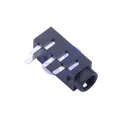
The PJ-320A is a panel-mount or PCB-mount DC barrel power jack connector designed for low-voltage DC power input applications in embedded and consumer electronic systems. This connector provides a reliable interface for external DC power adapters and is commonly used in development boards, communication devices, industrial electronics, portable equipment, and power distribution modules. The connector is engineered for stable mechanical retention and consistent electrical contact performance during repeated insertion and removal cycles. Its compact construction and standardized barrel interface support broad compatibility with common DC plug adapters used in low-voltage electronic systems. The PJ-320A is widely implemented in embedded hardware, battery charging systems, portable electronics, instrumentation equipment, and microcontroller-based applications requiring secure external power connectivity. Its durable housing and solderable terminal structure support reliable PCB integration and automated assembly processes. Engineering Specification Device Type DC barrel power jack connector Connector Function External DC power input interface Mounting Style PCB mount or panel mount depending on implementation Connector Configuration Coaxial barrel-style power connector Electrical Characteristics Designed for low-voltage DC power transmission Contact Structure Spring-contact conductive interface for stable plug retention Mechanical Features Durable insertion and extraction cycle performance Housing Material Insulated high-strength connector body Terminal Configuration Solderable PCB terminal interface Reliability Features Stable contact resistance and secure mechanical retention Assembly Compatibility Suitable for automated and manual PCB assembly processes Package Structure Compact embedded connector form factor Applications Embedded systems Portable electronics Power adapter interfaces Microcontroller development boards Battery charging systems Industrial electronics Consumer devices Communication equipment Instrumentation systems Low-voltage DC power distribution Manufacturer Commonly associated with generic DC power connector manufacturers #commonpartslibrary #dcjack #powerconnector #barreljack #embeddedhardware #electronicsdesign #powerelectronics #pcbconnectors #consumerelectronics #surfacemountcomponents #throughholecomponents #powerinput #industrialelectronics #microcontroller #electromechanical
112 Uses1 Stars2.54-2*20
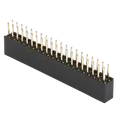
Female Headers CONN SOCKET 40POS 2.54mm DUAL ROW TH This connector consists of 40 pins total (2 rows × 20 pins) spaced at 2.54 mm pitch. It is widely used in PCB interconnections, embedded systems, Raspberry Pi-style GPIO headers, Arduino expansion boards, and general prototyping applications. It mates with standard female headers or jumper wires. Key Features Pin configuration: 2×20 (40 pins total) Pitch: 2.54 mm (0.1 inch standard) Mounting type: Through-hole (THT) Orientation options: Vertical or right-angle variants Contact material: Typically brass or phosphor bronze Plating: Tin or gold-plated options for improved conductivity Current rating: Commonly 1A–3A per pin (depends on manufacturer) Voltage rating: Typically up to 250V AC/DC (application-dependent) Compatibility: Standard 2.54 mm female headers and jumper cables Use cases: Development boards, GPIO expansion, debugging interfaces, mezzanine connections #CommonPartsLibrary #Connector
376 Uses1 StarsTYPE-C 16PIN 2MD(073)
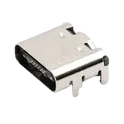
CONN RCPT Type-C 16POS SMD R/A The TYPE-C 16PIN 2MD(073) is a surface-mount USB Type-C receptacle connector commonly manufactured by SHOU HAN. It is designed for compact PCB applications requiring USB 3.1-compatible data transfer and 5V power delivery in consumer and industrial electronic devices. This connector uses a 16-pin optimized footprint (instead of the full 24-pin USB-C standard) where some contacts are internally shorted or omitted depending on application, making PCB routing simpler while still supporting basic USB-C functionality. USB Type-C female receptacle 16-pin reduced-layout configuration Supports USB 3.1 data transmission (application dependent) 5V rated voltage operation 3A–5A current capability (model dependent variant) Surface-mount (SMD), right-angle / horizontal mount Compact design for high-density PCB layouts Reversible plug orientation support (USB-C standard) Operating temperature: -25°C to +85°C Typical durability: ~5,000–10,000 mating cycles RoHS compliant, lead-free construction #CommonPartsLibrary #Connector
454 Uses1 Stars